The DIY face mask pattern in this post will teach you to make a pleated fabric face mask with either elastic ear loops or fabric ties.

If you can’t find elastic to make elastic ear loops, the pattern includes additional instructions to make and use fabric ties. You can make fabric ties from cotton fabric, t-shirt material, or ready-made bias binding.

You can make this easy fabric face mask with or without an optional interior filter pocket. The filter pocket allows the wearer to insert additional layers of filtration material if they so desire.

The pattern also includes instructions for inserting nose wire into the upper nose bridge section to create a better-fitting fabric mask.

A free printable PDF version of these pattern instructions is available at the bottom of the post. And you can watch the video tutorial on Youtube.

If you don’t have a sewing machine, I have a separate post with 5 Ways to Make a No-Sew Face Mask and another free pattern showing you How to Fold a No-Sew Bandana Face Mask.
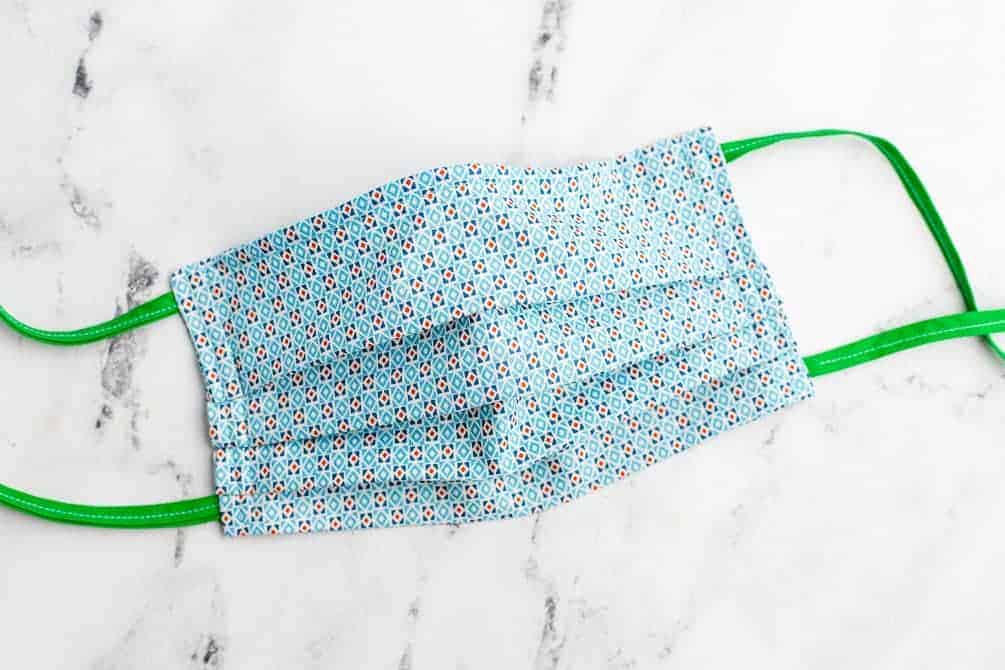
fabric mask for hospitals with filter pocket, fabric ties, and bendable nose piece

Is there a need for Fabric Face Masks?

Yes! The CDC says that the use of cloth masks can help slow the spread of disease.

Many makers have asked for a pattern to sew homemade surgical-style face masks for their families, communities, and local hospitals.

There is currently a high demand for all types of face masks. Since disposable masks are hard to come by, many people have been making fabric masks to use as protective face coverings.

Members of the community are encouraged to use reusable fabric face masks and other face coverings when in public, or in situations where social-distancing is difficult

What’s more, since there is such a high demand for protective equipment for healthcare workers, many hospitals across the country have requested homemade surgical masks as an emergency stopgap measure.

According to the CDC, fabric masks are a crisis response option when other supplies have been exhausted.

The CDC Now Recommends the Use of Cloth Face Coverings

Federal health officials now recommend people over the age of 2 cover their mouths and noses with cloth face masks when in public.

This is a voluntary public health measure meant to help “stop the spread” when people must visit public spaces such as grocery stores and public transit stations.

CDC is additionally advising the use of simple cloth face coverings to slow the spread of the virus and help people who may have the virus and do not know it from transmitting it to others.

Sewing a cloth face mask for yourself will allow medical-grade surgical masks and N95 masks to be reserved for healthcare professionals and patients.

Homemade Face Masks are Helpful

The Centers for Disease Control and Prevention (CDC) has explained that wearing a cloth mask can help protect the people around you, especially essential workers or other people with risk factors.

The CDC explains that while homemade masks are not a substitute for social distancing, they are an important tool for protecting ourselves and others.

Everyone should wear a cloth face cover when they have to go out in public, for example to the grocery store or to pick up other necessities.

CDC.gov

Making and wearing fabric face masks is important because it helps to reserve medical facemasks meant for healthcare workers.

I strongly caution you before you spend time sewing these masks:

  1. Follow the CDC guidelines as the situation develops.
  2. Contact your local hospital and clinic to ensure that they are accepting masks, and that any masks you make will meet their individual guidelines.

The Best Fabric to Use to Make A Face Mask

Researchers at Cambridge University tested the effectiveness of a wide range of household materials for use in homemade masks. They measured how well the household materials could capture and filter small particles.

Test data shows that the best choices for DIY fabric masks are cotton t-shirts, pillowcases, or other cotton materials. Using a double layer of material for your DIY mask adds a small increase in filtration effectiveness.

Other research has found that most effective masks were constructed of two layers of heavyweight “quilters cotton” with a thread count of at least 180, and had a thicker and tighter weave.

This face mask pattern has 2 layers of fabric, and an internal pocket in which you can add additional layers of disposable filtration material if desired.

An Important Distinction

Homemade face masks are not as effective as the N95 filtration mask recommended by the CDC, and are not a substitute for proper PPE.

Rather, they are meant:

  1. To respond to the hospitals’ requests for emergency backup masks.
  2. To help community members “slow the spread” in public settings where other social distancing measures are difficult to maintain.

Sources for further reading: Cambridge StudyNatureOcc. Env MedAnnals Occ Hygiene

Some Hospitals are Requesting Homemade Surgical Masks

Some hospitals and clinics accept donations of homemade face masks. Organizations like Masks for Heroes have a searchable database of facilities currently seeking donations. If you are wondering where you can donate masks, they can help you find a hospital or clinic that needs them.

Before you spend time sewing a large batch of masks to donate, please call first to ask if they are accepting them. You should ask if this face mask pattern (2 layers of fabric with a pocket for additional disposable inserts) will meet their requirements. You should also ask about drop-off/pick-up procedures.

materials for a fabric hospital mask

DIY Face Mask Pattern

The finished adult mask will be 7.75″ wide and 3.75″ tall.

View the full video tutorial on YouTube!

Materials

  • 100% cotton fabric (with a tight weave)
  • 1/8″ flat elastic for ear loops, or 4 fabric ties (you can use the same cotton fabric to make strips, use pre-made bias binding, or strips of cotton jersey)
  • fabric scissors
  • ruler
  • pins or clips
  • sewing machine and thread

Cut List

For an adult-size mask:

  • Cut 1 fabric rectangle 16″ long and 8.5″ wide (40.5 cm by 21.5 cm)
  • Cut 2 pieces of elastic, each 7″ long (or up to 8″ for larger adult size) (18 cm – 20 cm)

For a small child-size mask:

  • Cut 1 fabric rectangle 14″ long and 6.5″ wide (35.5 cm by 16.5 cm)
  • Cut 2 pieces of elastic, each 6″ long (15 cm)

For a large child-size mask:

  • Cut 1 fabric rectangle 15″ long and 7.5″ wide (38 cm by 19 cm)
  • Cut 2 pieces of elastic, each 6.5″ long (16.5 cm)

For fabric ties, if you aren’t using elastic:

  • Cut 4 rectangles 18″ long by 1.75″ wide (46 cm by 4.5 cm). Fold the long sides to meet in the middle, then fold in half again to encase the raw edges. Stitch down the length of the rectangles along the edge to create the ties.
  • 18″ may be too long for some people, especially kids. Please feel free to trim this down.
diagram showing how to sew fabric masks for hospitals

Step 1: Sew to the top side, with pocket

Fold the fabric rectangle in half, with the right sides facing each other.

Sew along the top 8.5″ width edge, using a large 5/8″ seam allowance. Leave a 3″ – 4″ opening in the center of this seam to create an opening for the filter pocket, and to allow the mask to be turned right side out after sewing. In the picture above, I’ve marked this opening with pins.

Update: Some people are finding it easier to insert/remove additional filter material if they make a larger opening. Instead of leaving a 3″ opening, you could make a 4″ inch opening.

materials and supplies to sew a face mask

Don’t want a filter pocket? If you don’t want or need a pocket, that’s totally fine. You will still need to leave an opening so that you can turn the mask right side out. After you’ve attached the elastic or ties (in the next step) and turned the mask right side out, you can stitch the opening closed. Then you can continue with the rest of the directions.
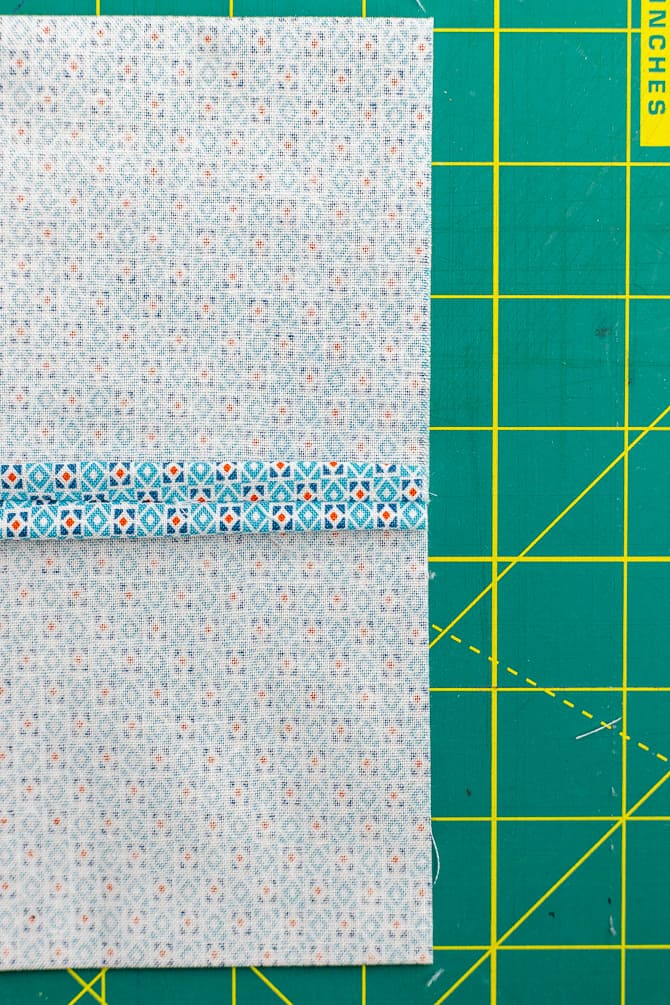
sewing the seam for the filter pocket in a fabric surgical mask

Next, turn the fabric so that the seam with the pocket opening is centered in the middle of one side. Using an iron, press the seam open.

Fold the excess seam allowance under, encasing the raw edge of the fabric. Topstitch or zig-zag stitch along each side of this seam to finish the edge. This will help keep the fabric from fraying when you insert and remove any filters.

See the next photo or the video for clarification.

sewing the seams for a homemade fabric surgical mask

Step 2: Pin Elastic or Fabric Ties

If Using Elastic:

Pin one piece of elastic to each side of the mask, one end to the top corner and one end to the bottom corner of the fabric rectangle. This will create the ear loop once the mask is turned right side out and pleated. Place the ends of the elastic about 1/4″ to 1/2“ from the top and bottom corners of the fabric.

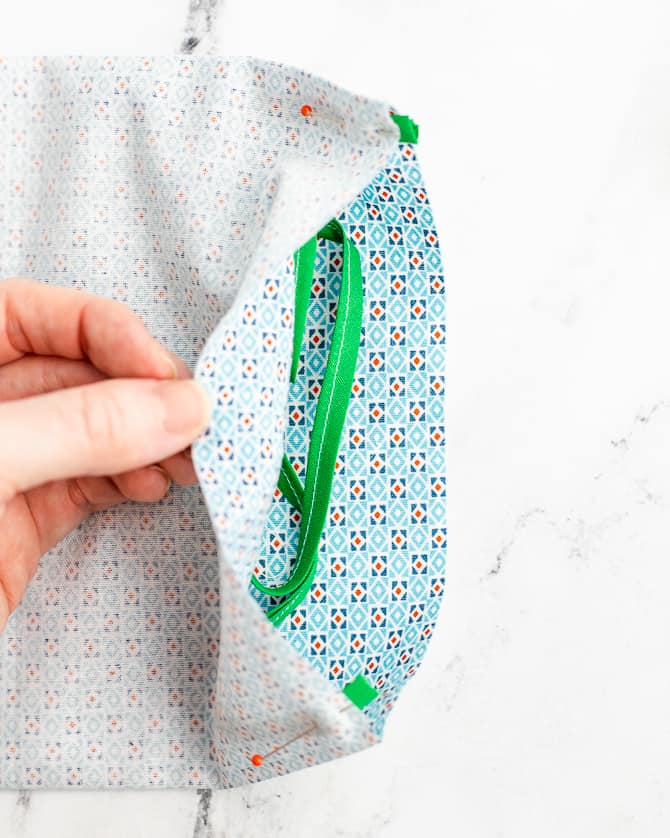
The piece of elastic itself will be sandwiched between the two layers of fabric. Once you turn the mask right side out, the elastic will be on the outside.

Repeat this process on each side to make two ear loops.

pinning fabric ties to the cloth mask
fabric ties or elastic on the inside of the mask before sewing

Alternative – Use fabric ties:

If you can’t find elastic, or prefer to use fabric ties, you can use 4 fabric ties, one in each corner. Each tie will be 18″ long. Sew one tie in each corner, being careful not to catch the ties in the side seams.

You can also use twill tape, bias tape, or strips from cotton jersey (t-shirt fabric).

The finished mask will then be worn by tying the fabric strips behind the head. See notes at the bottom of the post.

Step 3: Sew the Sides, Securing the Ties

With a 3/8″ seam allowance, sew each side of the facemask. Backstitch over the elastic or fabric ties to secure them. Trim the corners with scissors so that it will be easier to turn the mask right side out. Becare not to accidentally clip the stitches.

Turn the mask right side out and press with an iron. You can use a pencil to push out the corners.
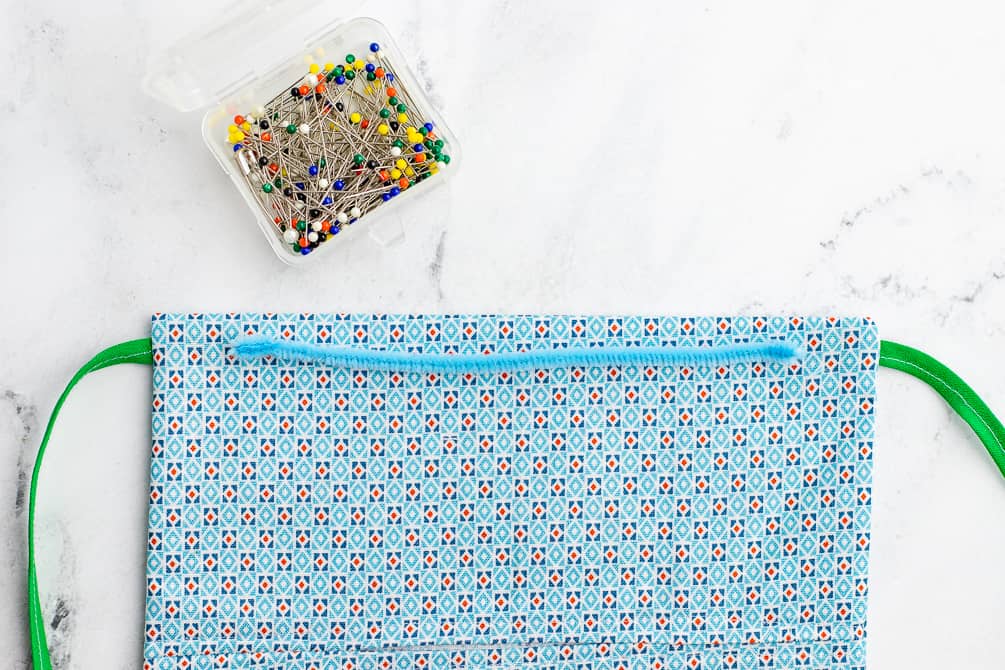
using wire to create a flexible nose piece on a fabric mask

Optional: Insert a Flexible Nose Piece

Cut a 6-inch piece of pipe cleaner, floral wire, or other flexible wire to create a nose piece. I folded the ends of the wire back into to keep them from poking through the fabric. Place the wire through the pocket hole and slide it up to the very top of the mask. Stitch around it on all 3 sides to keep it in place.
making the folds for a pleated face mask

Step 4: Make the Pleats

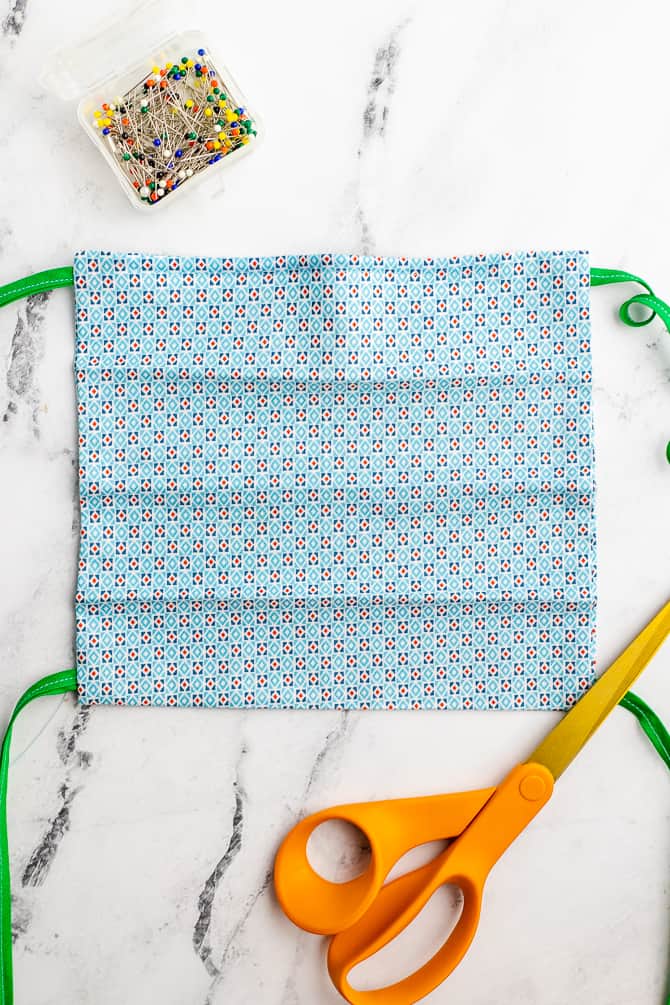
Make the mask with three evenly spaced lines. To do this, you can measure and mark with a water-soluble fabric pen. Or, you can do what I did, and fold the mask in quarters – fold the sides to meet in the middle, and then fold again in half. Use an iron to make a crease.
use pins to secure three pleats on a fabric surgical mask

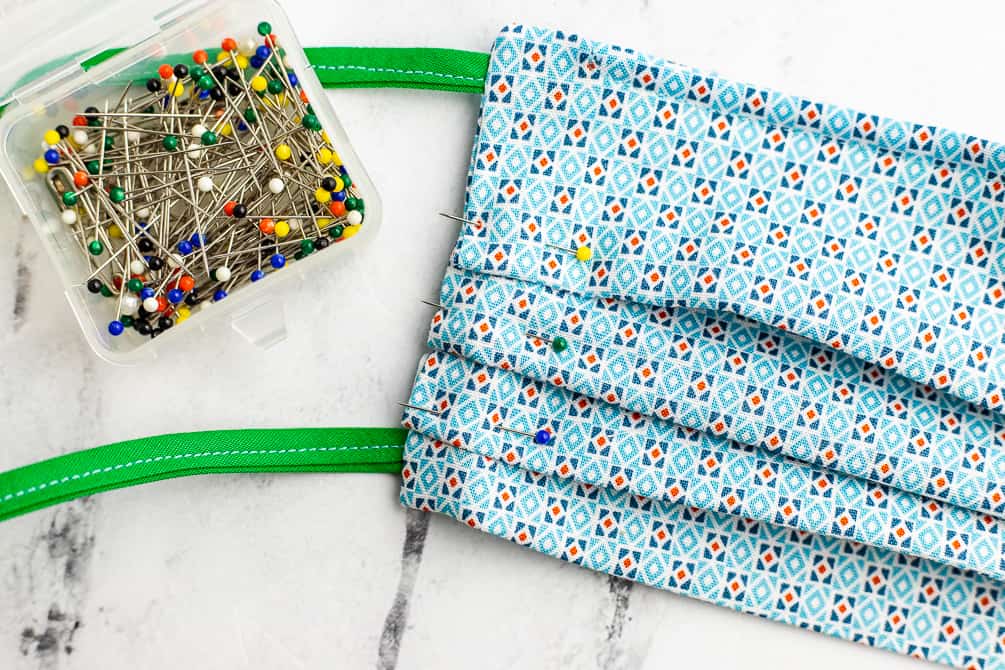
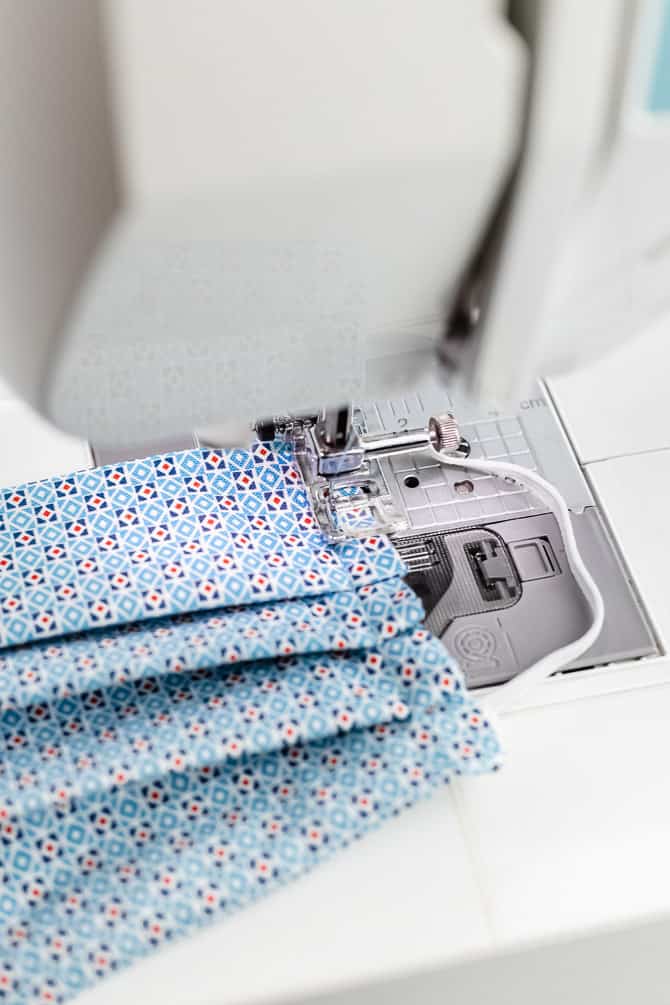
Use your markings to create three evenly spaced 1/2” pleats. Pin the folds down, and make sure all pleats are facing the same direction. Sew along the sides to secure the pleats. I like to sew down the sides twice, just to make sure.

When the mask is worn, the pleats should open downwards to prevent any particles from collecting in the fold pockets.
sewing down the pleats on the side of a fabric face mask for hospitals

Troubleshooting the Pattern

What if you can’t find elastic?

I’ve heard from many people that are having a hard time finding elastic. If you can’t find elastic to make the ear loops, you can make a mask with fabric ties instead. You can use ready-made 1/4″ twill tape, double-fold bias tape, or cut long strips of the same tightly woven cotton fabric you are using for the rest of the mask.

To make bias binding fabric ties: Cut 18″ long strips of fabric, 1.75″ wide. Fold the long sides together (lengthwise or hot-dog style) so that they meet in the middle. Then fold the strips in half again (lengthwise) to encase the raw edges. Stitch down the strips along the edge to create the ties.

how to make bias binding fabric strips that you can use to make face masks with ties

If you wanted these straps to have a bit of stretch, you could also cut long strips from cotton jersey or knit T-shirt material. The great thing about using jersey fabric is that it will form itself into a tube when you stretch it. And, it’s comfortable to wear since it keeps a bit of stretch.

Whichever option you choose, you’ll want to cut 4 pieces about 18″ long, and attach one strip to each of the corners. The mask will fasten by tying the straps behind the head.

What about metal to help the mask fit better?

To help the mask fit better around your nose, you can insert a length of flexible metal to the top inside of the mask, through the pocket insert opening before forming the pleats. Then, you can topstitch down around the metal insert so that it stays in place. I’ve seen people use pipe cleaners, floral wire, or twist ties.

I have another article all about how to add a nose wire to masks patterns and premade masks.

What can you use as a filter?

It is so important that everyone understands that while wearing a cloth face mask can offer some level of protection, it can’t protect against viruses the same way that an N95 mask can.

Many different types of filters have been suggested, like coffee filters, felt, and vacuum filter bags. Not all of these filters are effective, and not all of them are safe.

Without further research into the safety and efficacy of face mask filter materials, we won’t know what the best filter is.

Face Mask Filter Materials: Pros and Cons

  • HEPA filters. In testing, a layer of HEPA vacuum cleaner bag seemed to perform the best. However, it is difficult to breathe through. In addition, many people have raised concerns over the safety of materials (like fiberglass) used to produce these filters. At this time I can’t recommend them.
  • Coffee filters. One of the mask designs that the CDC has published includes a layer of a coffee filter. They are readily available and disposable.
  • Blue shop towels. Others have tested the efficacy of blue shop towels, like these. They look promising, but the data hasn’t been released publically or verified.
  • Dryer sheet or baby wipes. Because these items are coated in fragrances and other chemicals, I don’t recommend using these as a filter.
  • Non-woven interfacing. This has been suggested many times in the comments. I can’t find research suggesting it will help. If you choose to use interfacing, avoid the fusible/iron-on types.
  • Flannel or felt. These materials are not as closely woven as the cotton fabric on the outside of the mask, so it is doubtful they would improve filtration effectiveness. In addition, they may trap moisture.
  • One more layer of cotton fabric. The research we do have suggests that the safest and simplest option for a filter is cotton t-shirt material or tightly woven cotton fabric.

If you are sewing for hospitals, they may have their own medical grade filters. Always call before you sew to check their requirements.

Disclaimer: This pattern has not been industry-tested and is intended for educational purposes only. The decision to use this device is solely your own.

Where can you donate masks?

Not all hospitals are requesting masks, but many are. Search your local hospital to see if they have requested donations.

Many groups, such as the Sewing & Craft Alliance, are working to connect healthcare organizations with volunteer sewists. Check out their website, WeNeedMasks.org.

Also, an organization called Masks for Heroes has a website with a searchable database of facilities currently seeking donations. If you are wondering where you can donate masks, they can help you find a hospital or clinic that needs them.

How do you wear a cloth mask?

It’s important to use proper procedures when putting on, and taking off your mask. Be careful not to touch your eyes, nose, and mouth when removing the mask and wash your hands immediately afterward.

Here is a clear, step-by-step guide to the best way to properly wear a face mask.

Important to Note: Per the CDC, masks “should not be placed on young children younger than 2 years of age, anyone who has trouble breathing, or is unconscious, incapacitated or otherwise unable to remove the cover without assistance.”

How do you clean and sanitize a cloth mask?

Wear only dry masks. When masks get moist, even if it’s just from your breath, they need to be cleaned.

Wash masks regularly, with regular detergent and in hot washing machine cycles. Dry completely.

Free Face Mask Printable Pattern

Click here to download a pattern PDF

DIY Fabric Surgical Mask

DIY Fabric Surgical Mask

Yield: 1
Prep Time: 5 minutes
Active Time: 15 minutes
Total Time: 20 minutes
Difficulty: Easy

Homemade fabric surgical face mask to be worn as a last resort in a crisis situation.

Materials

  • cotton fabric, tightly woven
  • 1/8" elastic, or fabric ties

Tools

  • sewing machine and thread
  • scissors
  • ruler
  • sewing pins or clips

Instructions

  1. Cut the fabric. For an adult size mask, cut 1 fabric rectangle 16″ long and 8.5″ wide. Cut 2 pieces of elastic, each 7″ long. Or, cut 4 fabric ties 18" long.
    For a child-size mask, cut 1 fabric rectangle 14″ long and 6.5″ wide. Then, cut 2 pieces of elastic, each 6″ long.
  2. Sew the top side, with a pocket opening. Fold the fabric in half, with the right sides facing.
    Sew along the 8.5″ width edge, using a 5/8″ seam allowance. Leave a 3” opening in the center of this seam to create an opening for the filter pocket, and to allow the mask to be turned right side out after sewing.
    Press the seam open. Topstitch/zig-zag stitch along both sides of the seam for a neater edge.
  3. Pin Elastic or Fabric Ties. Pin one piece of elastic to each side of the mask, one end to the top corner and one end to the bottom corner. If using fabric ties, pin one tie to each corner, with the rest of the tie sandwiched inside the two layers of fabric.
  4. Sew the Sides. Sew the sides of the facemask. Backstitch over the elastic or fabric ties to secure them.
    Clip the corners, turn the mask right side out, and press with an iron.
  5. Sew the Pleats
    Create three evenly spaced 1/2” pleats. Pin the folds in place, making sure all pleats are facing the same direction. Sew down each side to secure the pleats.
    Note: When the mask is worn, the pleats should open downwards to prevent any particles from collecting in the fold pockets.


    Notes

    • Some hospitals are requesting a larger pocket opening for faster filter changes -- try 4".
    • For a smaller child size, start with a square that's 6.5" by 14".
    • For a larger child size, start with a square that's 7.5" by 15"

    Did you make this project?

    Please leave a comment on the blog or share a photo on Instagram

    A free pattern to sew homemade surgical masks for hospitals. Make a standard pleated face mask with a filter pocket and elastic ear loops or fabric ties from cotton fabric or t-shirt material.

    Remember, before you start sewing a huge batch of masks, please call the hospital or clinic and make sure that they both want and can accept homemade masks.

    Leave a Reply

    Your email address will not be published. Required fields are marked *

    673 Comments

    1. Hi, how many mask can you make out of a yard of fabric? Thank you!

      1. Fabrics come in various widths, but quilting cotton is usually 44 or 45 inches. You could get about 10 out of that.

    2. Shoe laces can be used as a tie.

    3. Pingback: Sewing Cotton Face Masks for Home Use – Puddleside Musings
    4. One more question, sorry! You say:

      “ Don’t want a filter pocket? If you don’t want or need a pocket, that’s totally fine. Just sew the seam all the way across, and don’t leave an opening. Then you can continue with the rest of the directions.”

      But… if we DONT leave a 2-3” opening in the seam, how do we turn it right side out again? What am I missing? thanks!

      1. AH thank you so much for pointing this out. Yes, you would still need an opening for turning. You could do it at this point or leave an opening when you do the sides. I need to go back and edit the post to clear this up. Thanks again for flagging.

    5. Ok, sorry for all the typos lol! Here is the corrected comment!

      Hi Sarah! Ok I am so sorry, but I’m confused about one thing. When you say:

      “ Optionally, topstitch: Press the seam open. Turn the mask right side out, and topstitch/zig-zag stitch along both sides of the seam for a neater edge. Turn the mask wrong side out.”

      Do you mean To zigzag stitch on each side of the seam you just made, closing the bottom except for 2 inches? How do I do this if the top is closed (b/c it’s the folded edge) and we’ve already sewed the bottom edge closed? I can’t make it fit under the presser foot… unless I’m supposed to sew through both layers of fabric? But if I see across that seam, when it’s on the middle, and go through both layers, except for the 2” opening, how can a filter then be inserted?

      Or, if we are only to stitch through the seam on one layer of fabric, can this be done w a machine, or only by hand? If with a machine… how???

      Thanks!

      1. Hi Lia,
        I think the video will help clear this up. You’ll press the seam allowance open, and stitch down that little flap of fabric on each side of the seam you just made. It’s supposed to help reduce fraying when you insert/remove the filters.
        You do have to bunch up the mask so that you’re only getting one layer under the presser foot. I’ll try to rework the written directions so that they are more clear.

    6. I’ve been using twist ties found in garbage bag and sandwich bag boxes. Pipe cleaners work well. Also check stationary stores for those clasps used in binders. (Sorry I can’t think of what they are called right now.)

    7. For the nose, I sewed a little length of thermostat spring into a pocket at the top. This or another similar flat (1/8 inch wide or so) lightweight spring would work well if you have it hanging around your basement. Most stores in my area are closed so I had to work with what I had!
      BTW a bandana provides the right amount of fabric for the mask and ties, with just a little left over.

    8. This pattern is great! Well-thought out design and good fit. I had never sewed pleats or darts before, so also learned some new things. I had a ripped bed sheet with very high thread count, so am happy to find a use for it. Directions were straight-forward, even for someone who had never done pleats and darts before. Thanks for posting this. Now that I’ve made one, will be sure to make more.

    9. I have been cutting the selvages off fabric to use for ties as they don’t fray.

    10. 2″ is not wide enough. I would double it based on other patterns I have sewn.

      For ties – strips of cotton jersey are the easiest.

      I used plastic covered paperclips for the nose wire.

    11. James cassidy says:

      It’s been suggested that different color material be used on each side to ensure which side is worn towards patients.

      1. ruthrawls says:

        I have seen that also. The outside pleats should be facing downward, which the medical personnel know, but the average public doesn’t know.
        Using 2 different fabrics will also extend your choices from your fabric stash. I have bits and bobs of smaller pieces.

    12. When you say “wear with pleats facing down,” do you mean the inside or outside pleats?
      Thanks

      1. Outside pleats, you’re welcome!

    13. It’s been a while since I used a sewing machine, so I used Stitch Witch. Seems to serve the purpose for a personal mask and very quick to complete. Admire the people who can sew, though!

    14. Hey all, just a few pieces of information/ideas. Air filters for heating systems come with particulate ratings. I have found that some of the furnace filters at Lowe’s and online have the ability to filter out particulate matter that is 0.3microns, the same size as what an N95 mask can. A filter with a MERV 13 rating, an FPR 10 or MPR of 1900 ,(it depends what brand you get for which rating they use), can filter out bacteria and viruses. Basically you are looking for a filter that can get particulate of 0.3microns or larger and this will/can ‘catch’ virus particles. The filter can be broken down and the fabric removed, flattened and cut to size to use as a filter for the mask.
      Please note I am not an expert on air filters, this is what I have been able to figure out based on virus particle size and reported ratings of different types of filters!

    15. Shawn Fujiwara says:

      hi wsa looking for the pattern to download- could not easly find it, too many replys to scroll through

      pls advise via email

    16. How must these masks be cleaned/sterilised after use? Many thanks!

      1. If you are just using them at home, washing and dryer on high heat should be fine.

    17. Thanks for this detailed information. You have researched and brought together much information that is available.

    18. Pingback: Make, Donate or Request Masks and PPE for Viruses - Volunteers Needed
    19. Debbie Jones says:

      Note about vacuum cleaner bags, etc: they filter great, but they are so uncomfortable they’re hard to use. Cotton fabric, even t-shirt or towel fabric, provides most of the filtration with wearability. Beware doubling up tightly woven thick fabric for the same reason. Try your first one on for an hour while you do dishes or vacuum or something. Sweaty thick masks won’t be worn.

      1. Yes, I do talk about this in the post. And even more information about fabric choices is in the research study I linked.

        If you are making masks for yourself, you are obviously free to experiment. And if you are making them for an organization, give them a call to see what they require first.

    20. Thanks for all the tips. Just one thing, Sarah, where is the big blue button? All I see is POST COMMENT.

    21. Sandra b Lamie says:

      Has anyone thought about using a coffee filter, the ones for a 12 cup coffee pot? Or another idea is interfacing fabric that can be purchased at any fabric store. Cut 1/2 the length, approx. 8.5″ wide X 7.5″ long. Stitch all around to mask fabric before folding, proceed with instructions.

    22. Nora Kruger says:

      Dear Sarah,
      This is wonderful and I’m so glad I found it. I much prefer printed instructions over a video, so I wanted to print this out, but the minimum # of pages would be 8. Is there any way the directions could be compressed into a few pages?
      Thanks, Nora

      1. Hi Nora,
        Did you try the large blue “Print” button in the How To section? The instructions will print on two pages, and the diagram will print on the third page. You can adjust your printer settings to print just the first two pages if you don’t need the diagram.

        1. Nora Kruger says:

          Sarah, Got it! Thanks. Do you think it would help to prewash the cotton, say in hot water? Nora

          1. Yes good idea, both to remove the sizing and to pre-shrink it.

            1. Nora Kruger says:

              OK, will do! And now I’m off to sew. I’m forwarding your site to the members of my quilt group. Nora

        2. I’ve heard that some bungee cords are filled with strips of elastic that can be used.

    23. Since I’m busy sewing I did not take the time to read everything, but I am using mid-weight tear-away (machine) embroidery stabilizer for filters. I also know folks using landscape cloth, I think it is called. The stuff to keep the weeds from growing that you put mulch over. Just an FYI.

    24. Susan W Fuller Esq says:

      To reiterate: it is very important that you WASH the fabric before making the mask. Fabric is preserved for marketing using formaldehyde, one of the chemicals in nail polish remover. Although good to preserve color and crispness for sale of fabric, not good to inhale!!

      1. Yes, also to pre-shrink it.

    25. I have used sails from a large sailboat. Thought of making ‘sail bags’ out of them and sell them for a lot of $ like some I’ve seen at Boat Shows.
      The material is Dacron, rather stiff, but will hold its shape and with a filter could be used more then once. Any one else thought of this?
      I’ve heard of a UK sail loft making hospital aprons en mass.

      1. I don’t think this would meet requirements.

    26. There is no “printable” version on this page. That’s what I need to move from computer to sewing table. Thanks anyway.

      1. Hello,
        At the bottom of the page, there is a large blue button that says “Print”. It will pull up a page with the instructions and a diagram for you to print.
        Thanks!

        1. The large blue “Print” button refreshes the page for me. Printing that screen produces 71 pages.

          1. Hmm, I’m not sure why you are seeing that. What browser are you using?

          2. Do a “print screen” of the instructions and then print the image you have “print screened”. You may need to scroll down and do 2 or 3 print screens in order to capture the entirety of the instructions.

            There are how to websites for “how to print pages from the web”. Please, let’s google *those* pages if we’re having printing problems, instead of making this incredible woman be tech support! She has already spent a huge amount of time making this site, taking pictures, writing up the instructions and variations! I feel
            like it’s not really her responsibility to ALSO teach people how to print from a web page 😉

            Thanks Sarah! You are amazing! This is the best mask sewing site I have found by far! ❤️

            1. Thank you so much Lia!! I know that the link you’ve found will be helpful to others!

    27. Karen Montgomery says:

      Instead of using elastic try what we call empty spaghetti in the swimwear industry. Use swimwear Lycra fabric
      Str. Cut 1” close with a 1/4” seam allowance using a serger being sure not to trim/cut the fabric as you’re closing. Using a “loop turner” turn the pieces right did out. Cut to the length needed. You can also cut longer length for ties too.

    28. Many thanks , Have made my granddaughter one & will be making some for the carers near me in uk .
      I’ve used bits & pieces I had around the home .
      Pipe cleaners for the nose piece,
      Old 100 percent cotton tea- towels ,pillow cases & T-shirt’s .
      For the elastic Ive reused old bra straps & knicker elastic .
      For the filter I’ve used sanitary pads ,& allergy dust sheets from bed .

      I’m also thinking That n95 filters are close to hep filters , from vacuum cleaner bags, air purifier machines .
      I’m also wondering if certain fish tank filters & dust sheets etc may at least give a little protection too ..
      I guess anything is better than nothing ..keep safe all x

      1. Yes, just check with your local hospital before you donate. Some hospitals are requiring only new, unused 100% cotton. Some have different requirements.

      2. haii sarah… i want to print out but when i click button print at the bottom , the page back at up..so sad i dont know how i get..pls help me..tq

        1. Hmm, I’m not sure. What browser are you using?

    29. I made one up and it is quite easy, however I’m wondering if the 2 inch opening is wide enough to insert a filter. If I make it longer (maybe 3 inches), am I compromising the mask in any way?

      1. That is what I’m wondering. I was told by my head nurse that if I could find a way to make a mask that could put a charcoal filter insert in it, that would work better than anything.

    30. Would a coffee filter work?

    31. I saw on utube a lady used panty liners as a filter,l’m sure that’s a fantastic idea.Thank you for this instructions.

      1. I think that would be very hard to breathe through and get hot very quickly. Your breath is body temperature. Just wearing a mask makes you hotter, something as non breathable as panty liners would be very uncomfortable.

        1. Right, I don’t recommend them.

    32. Pingback: Calling all Sewers – Renfrew Victoria Hospital Foundation
    33. Do I have to use cotton fabric? I have some polyester microfiber. Would that work?

      1. 100% cotton is recommended, at least by the hospitals I’ve seen

        1. Actually, some mask designers recommend that at least one layer be an unwoven fabric to better block splatter.

          1. I think non woven interfacing ‘fabric’ would work as a filter layer. I have seen a pattern using 2 layers of this stitched in between the outer fabric layers. The whole thing can then be washed after use.

            1. If you are making masks for personal use, that’s fine. If you are making them for the hospital you should contact the hospital to see what they want.

        2. I’ve read a bunch of articles and some are saying that polyester blends are better at repelling the moisture rather than just cotton. This made sense to me.
          Both are washable…
          Thoughts?

          1. The only study I’ve seen recommended cotton, but feel free to do your own research.

            1. I think it is only if it is the outer layer and inner layer cotton because you dont want moisture building up on the inner layer. if only one layer, cotton.
              Sorry for not clarifying. Thanks for all your hardwork!!! Love the design

    34. Would a thin strip cut from an aluminum drink can work for to secure the mask around the nose?

    35. Carol Dehlin says:

      is the the slit for the filter worn on the inside or the outsideinside

      1. I’ve seen instructions where the mask is made with two pieces, the inside is solid and the outside patterned.

      2. The opening in the mask is inside towards your mouth.

    36. How do you cut the filter material so that it fills the entire mask when the pleats expand, without leaving gaps for virus to come in ?

      1. You might need to experiment, depending on what you are using. Start with something 5-6″ square. But it’s important to adjust your expectations around “leaving gaps for the virus to come in”. This cloth mask is just not as good as an N95. That said, some studies say it’s better than nothing at all.

    37. Mary Morey says:

      Perhaps making a fabric casing then place the split elastic in it then sew it to the mask. That should keep it from fraying.

    38. Monica Hernandez says:

      I’m concerned the raw edges at the pocket opening will fray with repeated washings. I’m thinking of reinforcing the area with zig-zag stitches after step 2?
      Also, I inherited a ton of bias tape I was planning on using when my limited elastic runs out so thanks for the note on length for ties. From experience working with cot sheets (preschool teacher here) I know that elastic only has so many washes before it looses its stretch.

      1. Yes, that’s a good idea. I was thinking yesterday that if I made that first seam allowance bigger, I could even fold it under before zig-zag stitching it down.

    39. I made one up and it is an easy way to make a 3 folder filter mask, however I’m wondering if the 2 inch opening is wide enough to insert a filter. A none else have experience with this?

      1. Hi Karen,
        Yep, you can certainly make the pocket opening larger if you like. You are free to adapt the pattern as you need to.

      2. 2″ is not wide enough. I would double it based on other patterns I have sewn.

        For ties – strips of cotton jersey are the easiest.

        I used plastic covered paperclips for the nose wire.

    40. Parbriz LANCIA Lybra says:

      May I simply just say what a comfort to discover someone that genuinely understands what they’re
      discussing on the web. You actually realize how to bring a problem to light and make it important.

    41. Thankyou for this pattern and all the comments. My husband and I are both over 65 and live in s. Wales,UK He is the one going out during the lockdown for our food and meds, my dad is 90 and needs food and meds etc, plus he is registered blind and lives on his own. So these masks will make us feel a little more at ease whilst going through this crisis. I’m going to sew some up tomorrow.

      1. You’re welcome, Janet. Stay well.

    42. I have made similar masks and used Goody hair bands for ear loops.

      1. Yep, that could work. I think you’d need to adapt this pattern to make it wider though, since hair elastics are smaller than the 7 inches, right?

        1. The comment is regarding headband that go around the face and behind the neck, not those used for ponytails and buns. I have seen instructions for those as well. I’d think the thin ponytail style would hurt ears.

    43. kathy waldman says:

      I don’t have any more narrow elastic, but I do have loads of 1″and 1/2″elation. Would it hold up if I split the elastic lengthwise? Is thinking I could even Zigzag or serge along the elastic edges.. Your thoughts?

      1. Hi Kathy,
        I did try cutting a piece of thicker elastic into two thinner pieces, but it didn’t hold up for me. After a few stretches, it started to fray.
        What you could try is having the elastic go behind the head, rather than looping around the ear. So you’d sew them on the top side and bottom side, rather than the left and right side. Make sense?
        You’d have to try it out and see how large the loops would need to be, though.

        1. Cindy Clary says:

          Same here – I only have thicker elastic. Anyone know what length the elastic straps should be if making them behind the head? The nurses have said it’s pretty uncomfortable behind the ear with thick elastic.

          1. The doctor who did the video using the vacuum cleaner bags used 11 inches for the elastic.

            1. Well, there are going to be different measurements for different patterns.

          2. I’ve made surgical caps in the past. Using elastic with Velcro would be adjustable for comfort.

      2. It worked for me, but only if the elastic has ribbed “stripes” lengthwise. Cut along the stripes to 3mm, 1/8” width. No problem unraveling, and it actually made the edges softer and more comfy on ears!

    44. Violet Mae Lynch says:

      Should you wash the fabric first

      1. Yes, thank you for bringing it up. You should wash and pre-shrink your fabric first.

      2. ALWAYS! If you saw what I’ve seen in garment factories, you’d wash EVERYTHING before using!

        1. So true! Always wash EVERYTHING before wearing/using! I also worked in garment factories for many years.

    45. Attach the straps as directed for wearing over the ears, then fold them in half and attach a fabric strap in the center of the ear straps so that the mask can be tied in back of the head.

    46. You can use this for wire:
      TWIST TIES
      FLORAL WIRE or
      PIPE CLEANERS.
      Just be sure to stitch the wire in place under the wired area.

      Around the head straps can also be used. Just sew loops, as directed above out of strips of fabric. Then attach 2 straps in

    47. Animalaura says:

      I wonder if putting a folded dryer sheet inside the mask fold would add a layer?? Not all dryer sheets are thickly dense — but I’ve noticed that mine are. In fact, I save the used ones to put under table legs to make sliding the table around easier!

      1. Hi,
        I think that for the filter, people are trying to find .03 micron rated material.

        1. Janice Hoefert says:

          Hi Sarah, Read a article where 2 women are testing the filtering capability of several filter types. They discovered that shop towels are so far best filter. One brand is the Tool Shop towels that pull out like disinfectant wipes. They recommended a two layer system. Quite breathable as well. Have tested it yet but going to.

      2. I use dryer sheets to keep the mice out of my camper. I don’t know what the active ingredient is in them, but if a mouse won’t eat it, I would not recommend breathing through it.

      3. I thought of the used dryer sheets too, and I also save mine for different projects. I think I will try that for the masks I’m going to make for the family. Stay well everyone!

        1. Seems like dryer sheets are a scary toxic chemical issue, even after having been used for laundry. If rodents avoid them, let’s think this over, friends! Maybe if they’re washed several times after being used as intended, until all trace of fragrance is gone. I’m gonna try dry swiffer squares cut to fit a pocket sewn in the mask. Also testing thin organic quilting cotton batting, and poly fill from 1980’s style shoulder pads. Padded, push-up bras are in my rear-view mirror – life’s too short for discomfort! I’m going to try those little poly fluff half moons from bras (NOT the chemical synthetic foam ones).

          1. I would not use the batting. The wearer would get too hot wearing it. It also needs to be able to breathe easily through. I also would rethink the dryer sheets.

      4. Many people have allergies. I would not recommend using dryer sheets or swiffer sheets.

      5. Susan Mayhew says:

        If the dryer sheets are scented, it’s not a good idea.

        1. DO NOT USE DRYER SHEETS!

      6. The video I saw from a doctor said to use paper towels as the filter.

      7. I heard that a clean vacuum bag filter cut into pieces would work. Makes sense as it keeps super fine dust out. Some people have them laying around bc theyre basically obsolete
        I’d also imagine a coffee filter might add a little extra removable filter action.

        1. Lillian Farkas says:

          Maybe stabilizer that is used for embroidery machines would work.

    48. Anyone know where to get the metal inserts that go into the surgical masks.

      1. I saw a tutorial video where they cut a piece of metal out of an aluminum roasting pan.

        1. Where can I find the tutorial?

        2. you can use, pipe cleaners, small paper clips, bread ties x3, floral wire, craft wire, ect. Floral tape can be used to wrap wire to make it stronger. Your local hardware store would have all kinds of wire.

          1. Tip when using wire: Curl the ends if you have needle nose pliers, and/or tip the ends with dots of hot-glue, to make them less likely to poke through when the mask is washed.

          2. I should think you could also use aluminum foil rolled tightly and sewn in like the pipe cleaners.

      2. Would those thin green produce bag ties work? Would you need to glue it down so it doesn’t drift? Wondering too!

        1. It might, but you’d need to make sure that whatever plastic/paper covering on the wire would withstand the cleaning/sanitation process.

          1. Hi there, thank you for the tutorial!! Will pipe cleaners withstand being washed? I’m wondering about them rusting…

        2. Sigrid Lucas says:

          Glue may work but you can put the tag in place and than zig zag over it (big stitches) to keep it in place.

        3. Laurie smith says:

          Thank you for an excellent tutorial along with the visuals. Some of the questions remind me of my 5th graders who don’t read the directions but have so many questions! Sorry, just had to say. I’m going to make a couple of masks today.

          1. 🙂 You are very welcome!

      3. Meg Fortier says:

        I’ve been using a pipe cleaner folded in half, they work perfectly.

        1. Patricia Mullins says:

          Thanks for the pipe cleaner tip..
          what filter material is the most protective?
          and are ties better than elastic?

          I have been sewing over 50yrs…not so good at finding answers on the computer…the filter is most important and strong quilting fabric…Any help is appreciated…Oklahoma is not prepared…
          Thank you, Trisha Mullins

          1. Hi Trisha,
            Regarding the elastic vs fabric ties: It seems like it’s been hard to find elastic at stores, so a lot of people are using ties. If you are making them for personal use, you can do either. If you are making them for a hospital, you might call them to see if they have a preference.

            1. diana j erickson says:

              Regarding the ties versus elastic. Having worked as OR nurse for 27 yrs, I much preferred the ties. Some elastic seemed to either be too loose, or too tight. Ties give a much better fit

            2. Thank you for the feedback!

            3. Janell Dunsworth says:

              It’s taken me 2 days of searching the internet, but I have finally come up with my own pattern by combining ideas from all the different sites offering patterns and tutorials that allows for an insert. The best idea so far was the way for making ties out of old T-shirts. Soooo easy. Since elastic is at a premium, this is a time-saver and offers maximum flexibility for fit. It says to make them 18″, but my husband who is a retired oral surgeon thinks they’re a bit too long. Anyway, here is is the tutorial: https://www.madeeveryday.com/fabric-face-mask-free-pattern/

            4. Yes, this a good pattern too. I guess just double check that you can use previously used fabric if you’re going to repurpose t-shirts.

            5. Brandy Turpin says:

              Would beer (or can) coolies work?!

            6. I can’t say that I’ve tested it, but I can’t imagine that would be easy to breathe through.

          2. Joanne Palmer says:

            I agree with the author no vacuum cleaner bags!
            I heard and tried today washed reusable grocery bags. I took them apart with a seam ripper and Added as a Layer in between. Remember these do not protect you as much as they protect others should you be sick and not show symptoms. Distancing, and hand washing number one. Touching the mask puts germs on your hands so take it off before you enter your home but not in between your stores if going to more than one. Wash your hands and face when you are back home. Stay safe

      4. Kate Penswick says:

        Haven’t been able to locate the flexible metal strips but we read that you can use pipe cleaners floral wire or twist ties.
        Hope this is of some help.

        1. Bodro1962 says:

          I read someone using large vinyl covered paperclips.

          1. Yep, I’m sure people are using a variety of items. So, I think it would be best to run your materials by the specific hospital/clinic you are planning on donating to. I’d hate for you to make a bunch of masks that hospitals can’t be accepted.

            1. I’m not so worried about hospital requirements. My goal is to make homemade masks to prevent civilians from using hospital grade masks, which should be saved for front line heroes risking their lives for US!

        2. I found the soft, plastic encased plant ties work well if that helps

        3. Sherri Borth says:

          I’m using floral wire.from the dollar tree it has 6 feet per pack

      5. Susan J Gordon says:

        use pipe cleaner, cut to size. you can bend the end over and twist so no sharp edges. may want to topstitch around it when finishing to keep in place.

      6. I found the soft, plastic encased plant ties work well if that helps

      7. If you have any hanging file folders, you can put the metal hanging strips out of them and bend them into shape, they’re hardy enough to hold shape for quite a while

        1. Tori Carle says:

          The creativity of you and this whole group of people thinking about the comfort and safety of others makes my heart burst! Hanging file folders… What a great idea. I can imagine you going around your house looking at different things and thinking “Could this work… no. What about this… no. WAIT! THIS. THIS WILL WORK!”

          1. Perhaps aluminium foil cut to the correct length, and wide enough that it can be folded a number of times into a strip. That would give a flexible, durable nose piece. Heavier, BBQ foil would likely be better.

        2. Hardy isn’t best. The wire needs to fit across the nose and against the face. I’d think this is too stiff and will allow a gap. What have you noticed when wearing long term? Thanks.

      8. A small strip cut of floral wire with a turned loop or a dot of hot glue at the end to prevent wire from poking through the fabric.

      9. Vici Guns says:

        In the Garden Supply areas of stores, I bought 100 for $4 & the ties are about 8″ long. People use them to tie up their tomato plants & vines.

      10. You can use chenille stems. They can be bought in the dollar stores

      11. I got pipe cleaners in the craft section in Walmart

      12. Chris Connolly says:

        I use a piece of garden wire about 3″ long.

      13. Try straightening out a paper clip and sewing above and below it to keep it in place.

      14. Bonita Benko says:

        Metal for nose can be straightened safety pins, bag ties, thin picture wire, pipe cleaners.

        1. I work in electronics and I am thinking 18-to 20awg buss wire if you have access to it. To use it grab about a foot and a half with needle nose pliers at the end and pull it straight. Cut to the length you need and curl the ends with the pliers so it doesn’t poke. Its coated copper

      15. A paper clip works if you stretch it out but leave curled ends on both sides, put in place thru the filter hole and then sew around it to keep it in place.

      16. Nancy Dickerson says:

        I would think the boning strips that they put inside formal gowns and they would bend and unbend and that you can sew them right in. Its sold on a roll at what ever length you want.

        1. Sharon Sebesta says:

          I think this is the best idea

      17. Try pipe cleaners. They should hold during washing.

      18. Many of us using vinyl covered twist ties in nose area, that can be bent over nose.

      19. Coated floral wire is inexpensive and vinyl coated. It will go through several washes before showing rust and then only at the ends where it was cut. I’m going to dip my ends in nail polish several times for coating. It won’t last forever but should extend the time before rust spots appear by several washes.

      20. I bought some garden twine and I have plaited 3 lengths together and it seems to work well. Another option is the plastic covered wire that you get in freezer bag packs but I feel these are too short and wont last long. the garden wire is plastic coated but plaiting it gives it strength and is still flexible.

      21. What about twist ties?

        1. What about leaving one end of the stitched tube for the wire strip to be removed for washing? Slide it out to wash, slide it back in when dry.

      22. I’m using prong fasteners. The long ones like you’d put a thick report together with

      23. Pipe cleaners work really well, too

      24. Denise Hawryluk says:

        I use pipe cleaners that are on Amazon. They work great! One to each mask.

      25. Mary in mn says:

        Plastic twist ties would work and still be washable. Wash in hot water with detergent/no softeners. 160 degrees kills the virus, that’s the silk setting on my iron. ( you can test your iron temp by using a meat thermometer pressed to the bottom). Don’t iron the plastic twist tie.

      26. I have seen a lot with pipe cleaners – like for crafts..

      27. I think that the bendable strips used to close the bags that ground coffee comes in would be a perfect answer for the nose fittings. You can cut them to the length you need, maybe getting two per strip. I’ve been saving them for years to use instead of twist ties. They’re heavy weight, and the plastic covering ( so far) has not shown any propensity to come off after use in the freezer.

      28. miriam's mats says:

        Use pipe cleaners, cut in half.

      29. The easiest things to use are pipe cleaners or twist ties.

      30. Cut up an empty soda can but make sure you fold the cut piece over itself and sew into the pocket sharp side pointing down

    49. Catherine Douglas says:

      What is the measurement of the finished mask?
      That is once the pleats have been sewn down.
      How far down is the 1st pleat?

      1. The finished mask is 7″ wide and just under 4″ tall. So once you get to the pleating step, divide the mask with 3 evenly spaced lines. Then you can use these marks to create the half-inch pleats.

        1. Joanne Palmer says:

          My son has a broad face and we found to start with a bigger rectangle works well so it’s 9.5 finished and 5.5 chin to nose. Bridge

          1. Thanks for the variation!

    50. Approximately how many masks were you able to do using one of the filters? I work in a healthcare office and while we don’t need to wear surgical masks these would be a great option for those of us who want a bit extra protection. Thanks!

      1. Hi there,
        The size of the inner filter material would be about 6″ square, as far as what would fit.

        But, I suppose it would depend on what you’re using for the inside pocket filter material. I have seen some people just using tissues, or extra layers of cotton or fleece fabric. I know one hospital is asked for masks made with 0.3 micron filter material. At this point, to my knowledge, there isn’t an official universal recommendation about what to use.

            1. Can you use cheese cloth for a filter

            2. I think, since cheesecloth is more loosely woven than regular fabric, it wouldn’t provide any additional filtration.

            3. Diane L Buskirk says:

              Are you selling any. Have health problems can use some please.

            4. No, I am not selling masks.

            5. Kathleen Wallace says:

              Do not use vacuum cleaner bags or ac or furnace filters.
              These all have chemical coating and are made for high volume air flow!

          1. Marcie Castillo says:

            Thanks, Dawn!

          2. Betty Anne says:

            I have seen masks made using the pleated 3M material in furnace filers..the better ones says virus include on pkge

            1. Could you post a link to that item. Or the item number. Couldn’t find it on Lowe’s.com thanks!

            2. Mary Vann says:

              Does the filter need to be replaced daily?

            3. 3M Advanced Allergen filter is what we found to use which is the purple label. We hope it works!

            4. Kathleen Wallace says:

              Do not use AC filters they may release small particles that can get into your lungs and cause irritation. Theya re for large air flow volume not for breathing a few inches from your lungs. Also many of these are coated with chmicals to incrase the particles that it catches you woul dbe putting those into your lungs.

          3. If you use the vacuum cleaner bags, what happens when they are washed or do they throw the masks away and never wash????

            1. Some people are using filters to put in the pocket, and changing them out regularly.

          4. 2 layers of cotton t shirt material equal a surgical mask.

            1. No, they aren’t equal. Fabric masks will not substitute for real PPE. They are a last case option.

          5. you can also use high allergy (like hepa) furnace filters. they can filter up to10.0 microns. You can purchace filtersthat aren’t framed in at lowes. Brand I have is called best air, it’s for use in furnaces that have louvered filter frames.

            1. Mary Vann says:

              Does the filter need to be replaced daily?

            2. If it’s disposable, I’d replace it as often as it becomes moist.

            3. I’d replace it daily, or whenever it becomes moist.

            4. What i have seen recommend by a Dr is the Hoover Hepa vacuuming bags. They are 99.9% Effective as dust won’t flow through them

            5. Kathleen Wallace says:

              Do not use furnace filters! theya re not made to be a few inches from your lungs. They are made for high volume air flow and also contain chemicals that help them retains dust!

          6. Do you have any idea what size Ricar bag she used?
            Thank you
            Faye

          7. Yes! A coworkers spouse has been making some of these while she could get the supplies so they could be used on ambulance since N95 masks have been in short supply along with the surgical masks. Thank you to everyone making them to help keep all of the healthcare & first responders safe, we appreciate you!

          8. There are also furnace filters you can use. They have to be at least 1900 microparticle performance rating (mpr). The are the 0.3 measurement needed, and anything lower than 1900 will not work. You have to remove the cardboard edges and mesh, but because the fabric part is folded, one filter will give you tons of material.

            Here’s a link to a video with an explanation:
            https://www.investmentwatchblog.com/n95-mask-material-and-how-to-make-your-own-effective-masks-plus-uv-light-to-clean-and-reuse-your-masks/

            1. 3M has stated to NOT use furnace filters. Plus, they are really expensive

          9. Those hv chemicals too be careful

            1. They say some contain fiber glass, so be extra careful!!

        1. Thank you so much for posting this! This will be my first sewing project, but my husband is a nurse at a hospital that is so low on masks that they wear them until they tear, and are now limited to only getting one if the patient is clearly infected. I’ll figure out how to sew if it means that he and his coworkers are even a little bit safer.

          1. You are welcome. Pass along my thanks to your husband. Stay well.

          2. Janet Neaterous says:

            My daughter is a lab tech and she is one-on-one Direct contact with the blood samples for Coronavirus. We are making masks that they can wear. Where are you from maybe we could send you some

        2. Donna Kinne says:

          Do you think Swiffer dry cloths would work for filters? They do trap dust, etc and allergens

          1. A lot of things sound good, but without proper testing we don’t know what is effective.
            Test data we do have suggests that the best choices for DIY fabric masks are cotton t-shirts, pillowcases, or other cotton materials.

            1. Diane Sindelar says:

              Do you think quilt batting will work for the filter?

          2. Sandy Brigman says:

            I think I may try that. Makes sense

            1. I have been making a different style of mask (without the pleats) but with quilt batting between the two layers of material. As you have said we will not know the effectiveness, but I have found it helps with the breathability of the mask (and therefore can be tolerated for much longer periods of time).

          1. Catherine Reaves says:

            I have seen coffee filters suggested on another site. Cheap and easy to sway out IMO.

        3. What about sanitary pads as filters. panty liners with their sticky side out and the soft side against the face.

          1. No, I don’t recommend it.

          2. Sounds like a plastic bag obstructing air flow…

          3. It has to be a material that you can breathe thru.

            1. Ofelia Carbajal says:

              How can you insert filter thru 3″ opening on top of mask and how do you enclose pipe cleaner (on just one side of opening or on both sides) please

            2. The opening is meant for a disposable filter, so you would change it out through the opening.
              For the pipe cleaner, push it up as close to the top as you can, and sew along the three other sides.

        4. Elizabeth says:

          Would the opening for the filter be on the outside or inside of the mask?

          1. Most people are wearing it inside.

            1. Elizabeth says:

              Thank you. This is a fabulous tutorial. Mask worked out great in spite of my poor sewing skills. Will be making more.

        5. Would a coffee filter be of any use as a filter in the face mask ?

          1. Catherine Reaves says:

            I think so, but would use several layers (I’m using Mr. Coffee basket stylef) & cut them into rectangles.

        6. Deanna Mackey says:

          A filter suggestion for diy face masks for personal use only (not for hospitals or medical staff). Dried out clean, unused diaper wipes. Wipes can be dried quickly if hung, and can be cut in half for two filters or whatever size you need. They’re economical and widely available, so you can change frequently.

        7. RaeLynne Anthony says:

          I just wanted to ty for your pattern & informational post. I’m a retired nurse & one of the “high risk” (60’s + multiple myeloma & on chemo). My neighbor’s husband is EMT & firefighter. And my other neighbor does cleaning for elderly clients. We’ve all been looking for solutions to keep safe & healthy
          Thank you again & Blessings to you & yours

        8. Gerri Benavides says:

          The best thing I had heard is the blue shop towels have the closest filtration for the virus.

      2. Charlotte says:

        For ties, you could also use strips cut on the bias and sewn together. This is what quilters use to bind their finished quilts. Cutting on the bias gives the resulting strip a bit of stretch.

        1. Even though bias tape has some give, it’s not enough. Someone suggested repurposed T-shirts be used for the ties, not the body of the mask, mind you. As a daughter, sister, cousin and niece of physicians, nurses & paramedics I can assure you those in the field want stretch in the tie. Fabric, even on the bias, Is too flat, slips down or up with any movement of your head and elastic is too loose or too tight so the T-shirt or similar jersey knit fabric is much preferred for ties especially since these folks can’t/don’t want to be putting their hands near their faces to adjust or pull it back up/down. Hope this helps.

          1. Yes, cotton jersey is a great option!

            1. if the public begins wearing these would they be disposable after one time use or could they be
              laundered and reused ? Also is there a protocol for removing and disposal? You dont want to wear it thru the grocery store, remove it in the car and toss it out the window or set it in the seat beside you for future use. It may be contaminated and would be a source of infection.

            2. Keila Petronek says:

              Can 3/8 in ribbon be used for ties?

            3. Yes it should work, as long as it’s strong, washable, and comfortable to wear.

          2. Would use tee shirts jersey strips cut narrow for ear loops only.

          3. I have read many places that repurposed t-shirts are a great option to use for the mask itself also, why do you say not to use?

            1. The fabric weave would not be tight enough. You can use t-shirt material for the straps, though.

          4. Chantell Tenorio says:

            Great idea! Thank you

          5. Would you use the jersey as a tie? How many inches would you cut? Does it matter if it takes more time to tie versus slip over ears?

            1. Yes, the jersey would be the ties. It might take more time, but a lot of people can’t find elastic to purchase. I would start with maybe 14″ long, and you can always trim them down. Let me know how it goes.

          6. But regular surgical masks have ties with no give.

          7. Your comment makes so much sense, haven’t started to make them yet…trying to read as much as I can about the best fabrics and filters and suggestions from people in the know. I am a seamstress and have been asked to do this so want to be sure what I do will be helpful. Thank You very much for your comment stay healthy. Sewsewgirl.

          8. Instead of sewing the ties into the mask, I used four, 1-1/2″ pieces of elastic. After turning and sewing the pleats, I sewed biased tape to the elastic ends to finish the ties. This was easier for me. I have really fine hair which gets caught in the elastic. Still experimenting with various lengths and widths of elastic.

      3. Lynn Embley says:

        What about coffee filters or scientific paper filters as inserts?

        1. lisa benton says:

          Coffee filters do not work. Best thing that has been found so far is blue shop towels for filters

          1. Since most of the posters here are women, you probably have not thought of this, but a small sewing company tested various kinds of filtering materials and they found that a SPECIFIC two 2 brands of Blue Shop Towels worked the best down to 3 microns which was the farthest they could test with their equipment. Tool Box shop towels and Zep’s Industrial blue. I got the Tool Box ones at $8.99 for a 200 towel roll at Menards but other places like Harbor Freight also sell them . I compared they to 2 other brands that I have here and they are definitely different. They were selling like hot cakes and were stacked up in cases at the check out registers. They are easy to breather through and sew or glue. You could use them to make the entire mask or just the insert filter for your cotton ones. I have made a few rudimentary masks out of them. I am 75 years old and have not touched a sewing machine since it was 12 or 14 so I have been doing a lot of iron on gluing instead. Sewing is not my forte. Neither is typing. You might want to read this article:
            https://www.businessinsider.com/homemade-mask-using-hydro-knit-shop-towel-filters-better-2020-4

            I also have one mask I keep in in my car. To sanitize it after use, I spray it with 91% (70% will do) isopropyl alcohol from a spray bottle and leave it hang dry from my mirror when I exit the car.

            On ultraviolet light, only a specific frequency light will work (UVC). That frequency and the intensity required is dangerous to your sight. If you are going to do this Get the correct light and put it in a box with the mask(s) for eye protection before turning on the lamp.
            https://en.wikipedia.org/wiki/Ultraviolet_germicidal_irradiation

            1. Yes, I talk about this and link to this article in my post.

        2. J. poirier says:

          Are anti viral Kleenex tissues breathable enough ..or a possible filter choice?

      4. David Zielsdorf says:

        A great solution for the nose piece is to use a piece of aluminum. You say but I don’t have have one…. Solution is: grab your favorite empty beverage can. Insert your scissors directly into the can near the top horizontally trim in a circle removing the top. Slice from top to bottom make a similar cut at the bottom. Trim clean edges with scissors. Wash the rectangular piece of aluminum thoroughly (maybe in dishwasher). Cut 1/4″ strips off can horizontally. Fold your 1/4 ” strip in half the result will be approximately 4″ of nose piece metal. Fit centered into top of mask. Do a lock stitch near one end. Set machine for “Wide zig-zag” stitch directly thru cloth and aluminum. Finish with locking stitch at far end. Nose piece will work and hold cloth near face, as well or better than the commercial dust masks.

        Remember be extremely clean wash hands before start and after any contact with face. Masks can be washed or at least left on a table in the sun for a period. I place completed units into individual sandwich bags. I found a roll of coarse household cotton string that worked well for personal not heavy use masks. Tie an overhand knot in each end of the tie and stitch in place.

      5. Joanne Palmer says:

        Thank you great explanation for some one who hasn’t sewn in years. My question is 18 inch ties seem really long? Is there a range?
        Thank you

        1. Yes, you can certainly trim them. I suggested a long length so they would work for many sizes.

    Similar Posts